

Questions Unlock Process
How God’s questions in Genesis 3 show us what his intention were and what they are for us today. Part 3 of a series in Genesis 3.

“What do you mean?”
I was taken aback, at least at first. I thought for sure that we were on the same page.
I was sitting in an office, chatting about a partnership agreement with someone I respect a great deal and whom I am deeply intimidated by. What I initially took to be curiosity turned the corner on this one question. Those four words didn’t span the gap between us, but they certainly highlighted it. The words I was using, words shared in our faith heritage, meant different things to each of us. My use was shaped by my time in wide-open, ecumenical waters – I was working with what I thought was the most basic, commonly-held definition; this person’s understanding was colored by a specific school of thought they were steeped in.
The lack of shared understanding of the same words set us worlds apart from one another. It would take many more conversations for us to navigate a way forward. What I had taken for granted – what I wasn’t curious about – hung us out to dry.
Questions are incredibly powerful. They give shape to our curiosity –or lack thereof. They invite exploration. They clarify misunderstandings. Questions always serve a purpose and highlight a process, and that process can tell us a lot about the intentions behind the process.
Today, we’re going to continue our exploration of Genesis 3 by focusing on the questions God asks and what they reveal about God’s intentions.
To read the previous posts in this series, click here:
Entering Conflict - God and the People
Genesis 3 is an incredibly important passage in the Bible. It’s talking about things that happened, sure, but it’s also talking about things that always happen. We often read Genesis 3 with the end of the story in mind: the people are expelled and punished; they don’t get to live forever; and sin keeps rolling downhill, picking up speed and hurting more and more people as it goes on.
But I want to push us to not rush to the end.
I want us to let the story unfold for us, like we would if we were reading a novel or watching a movie. I want each line to breathe. That’s really a core piece of this project for me: I want to let Genesis speak to me like a friend telling me their story: even if I know how it’s turned out so far, I don’t want to make assumptions and jump to conclusions. I want to honor the story-teller and see what there might be to learn.
That said, Genesis 3 feels like a conflict story.
We have our main characters: God, Adam, Eve, and the serpent. The serpent is shrewd and manipulative: even the words that the serpent uses are slippery half-truths. This character is set up as an antagonist in the logic of the story: without the serpent, it would seem, there isn’t any conflict to speak of. We have our victims-turned-co-conspirators: Adam and Eve take the serpent at its word and do the very thing God had told Adam not to do earlier in the story (Genesis 2:15-17).
By the end of Genesis 3:7, as the man and woman make clothes to cover their nakedness, I am poised and expecting conflict. As someone who loves good stories (and shares his few good stories ad nauseam), I’m on the edge of my seat waiting for the fight to break out.
There isn’t a fight, though.
As we discussed in the last post, God’s first response doesn’t seem to be to mobilize into fight or flight: he doesn’t come looking for a fistfight to set things right, and he doesn’t run for the hills either. Instead, because he isn’t us, he is somehow able to stay relational and curious as a first response when things go sideways.
So God doesn’t fight his people. But that doesn’t mean there isn’t conflict. Genesis 3:8-24 is rife with conflict – God engages Adam and Eve; God engages the serpent; God even engages the angels in the midst of all this!
But there’s a difference between engaging conflict and fighting, isn’t there? The outcome might be similar, but the process is vastly different. Conflict is about telling the truth and setting things to rights; fighting is about getting what I want (or at least trying to). Rather than coming in swinging, making accusations at the first people, God comes in with questions.
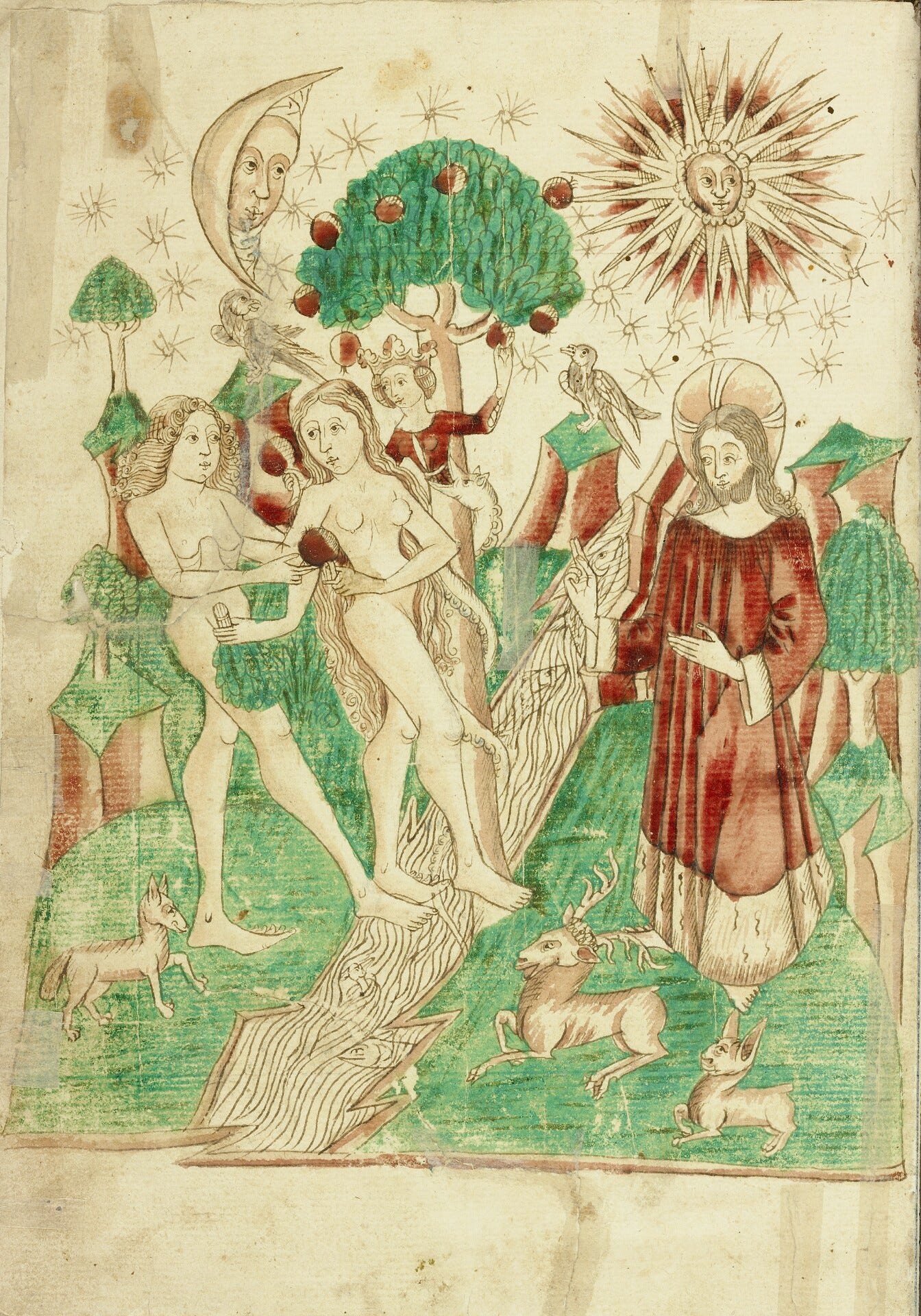
God’s Process: Three questions out of Genesis 3
What can we learn about God’s process from this story? How might taking this short section seriously change how we understand the whole story?
If we assume that God has intentions behind his actions (I do), and we assume that the writer of Genesis wants us to know about these things (I do), then we should be able to distill a bit about God’s intentions and process from a good, close reading of the story. I think that God’s questions serve as helpful proxies for seeing God’s heart for these people…and for us, too.
God’s heart is to locate his people (and for them to learn how to locate themselves).
The first question God asks is what I call a “locator question,” a question that is designed to help us locate what we are looking for and, in the context of a relationship, to help us and others discover where we are. God calls out, asking, “Where are you?” (Genesis 3:9 NRSVUE).
There is no indication in the story (so far) that God is angry. In fact, the phrase “at the time evening breeze” (Genesis 3:8 NRSVUE), sometimes also translated as “in the cool of the day” (NIV), is the Hebrew phrase rûahk yôm, which is made up of the same word used for spirit, breath, wind, and God’s Spirit, and the word denoting either “day” or even “age” or “era.” The context shows us that when God is searching for his people, it is in a time marked by the cool, stabilizing, and consistent presence of life - that even after the people knew shame, God was walking unhurried and as someone whose context is marked by life-giving presence, without end.
All that to say, we shouldn’t think about how strange it is for God to be walking about in and around His people; instead, we should find it odd that the people were hiding when all indications of God’s activity seemed to be the same as they always had been.1
I’m going out on a limb here. What if God isn’t a mad dad demanding to know where his disobedient kids are? What if God is a co-regulating parent, searching for his frightened kids? In this light, we see that His locator question is designed not only to help them find him, but also to help them locate themselves.2
He wants them to come out of hiding and to see that He is not very far from them.
God engages with us the same way. He seeks to draw us out, and to help us understand where we actually are (relationally, emotionally, spiritually, and, I suppose, physically, too). He wants us to see where we are and understand, like David did, that there is nowhere they can go to where they have left God or, importantly, where God has left them:
Where can I go from your spirit?
Or where can I flee from your presence?If I ascend to heaven, you are there;
if I make my bed in Sheol, you are there.If I take the wings of the morning and settle at the farthest limits of the sea,
even there your hand shall lead me, and your right hand shall hold me fast.If I say, “Surely the darkness shall cover me, and night wraps itself around me,”
even the darkness is not dark to you;
the night is as bright as the day, for darkness is as light to you.For it was you who formed my inward parts;
you knit me together in my mother’s womb (Psalm 139:7-13 NRSVUE).
But, importantly, this is a reality that must be discovered through experience. You can tell someone until you are blue in the face that God hasn’t left them, and yet, until they know it for themselves, it is unlikely to “stick.” God gets that, and he gets us, so He invites us into the process of discovering where we actually are and how close He actually is.
God’s heart is to help his people process (and for them to learn how to process difficult situations)
In response to the first question, the man confesses that he heard the Lord in the garden and hid because he was naked (Genesis 3:10). This is a curious statement in the context of the narrative in Genesis 2-3: we know that the man and woman were naked and unashamed (Genesis 2:25). They were naked, presumably, in the presence of God himself. Yet, if we take the narrative at face value, God is surprised at the man’s admonition. In the innocence of the garden, the people didn’t know nakedness because they didn’t have a referent for covering up with clothing.
In order for them to know this, the narrative presumes, someone must have told them.
Curious and, perhaps, worried, God asks him a question.
The second question God asks is what I call a process question. A process question has one goal: eliciting a story. In asking Adam “who told you that you were naked? Have you eaten from the tree of which I commanded you not to eat?” (Genesis 3:11 NRSVUE), God invited Adam to tell him the story of what had happened for God’s sake and for his.3 God wants to know what happened, and he wants Adam to know what happened, too.
A story certainly has a beginning, a middle, and an end. But a story also has characters, and what we know is that, in this story, the only credible character to share knowledge with the humans is God himself.
We require “storying” our experiences so that we can live with them.4 In the absence of a story with a beginning, middle, end, and characters, our bodies become trapped in a moment that exists perpetually, unable to move beyond the psycho-physical triggers that send us reeling.5 In my work in missionary care, we find that debriefing gives people the footing they need to walk forward rather than being stuck trying to live into a life that is no longer possible – as they tell their story of life overseas, they learn, experientially, that the story is over and it is time to begin a new story.6
Why is this? There are a lot of answers to this question, but I think one helpful answer comes from Jeremiah 17:
The heart is devious above all else;
it is perverse—
who can understand it?
I the LORD test the mind
and search the heart,
to give to all according to their ways,
according to the fruit of their doings (Jeremiah 17:9-10 NRSVUE).
While this verse is often ripped out of context (I wrote briefly about some of the implications of this passage here), the thing to note here is that, regardless of what deceitful means, it seems that the internal world of any given person is endlessly complicated. Only God has total access, and even I don’t have mastery over my own story. We need His help to find coherence of our story with reality as it actually is.7
In this story, we see God actually doing what He seems to be saying He must do in Jeremiah 17. He is the one who searches hearts (Romans 8:27), and in the search, He invites us to make greater sense of our experience.
However, Adam buries the lead. He decides to blame the woman rather than name the truth about what has happened (Genesis 3:12).
A good principle to keep in mind with the Bible is that what happened then is always happening. What Adam did is what people always keep doing. You only need to look at the headlines to see that blame-shifting and refusing responsibility seem to be human bread-and-butter.
But, importantly, God doesn’t end the conversation or shift his gaze.
He stays with them.
He stays curious.
As the people unpack their experience and attempt to tell the story, God doesn’t shy away. Even as the man shifts blame away from himself and onto the woman and God (“The woman whom you gave to be with me…” (Genesis 3:12 NRSVUE)), God stays with them to help them tell the truth and come out of hiding.8
God’s heart is to help his people take responsibility (and for them to learn how to be responsible)
God turns to the woman for clarity in light of the man’s blame-shifting cowardice. As I read the story with fresh eyes, it’s as if God is deliberately withholding judgment to remain curious.
God is giving them the benefit of the doubt.
So, he turns to the woman and asks another question: “What is this that you have done?” (Genesis 3:13 NRSVUE).
While there is a reading of this text that rings with accusation, I don’t think that is what is going on right here. Instead, I think God is asking a responsibility question. These questions are designed to facilitate an honest conversation about who owns the outcomes of a given situation. While this is perhaps a leading question (I can certainly see an argument for that), I think God is asking this question to Eve for both her and for Adam to answer – in a sense, God is giving them a chance to take responsibility.9
It is here that we could end up in a swirling debate about the nature of the sin and what is going on, but I think the tree was not some trap designed to ensnare the first people.10 It could have just as easily been anything else. I think, with Brent Strawn, that what is at issue is the first people taking wisdom rather than receiving wisdom within the context of a loving relationship.11 Rather than diverging further, it is enough to acknowledge that something went seriously sideways, and the people have an opportunity to own up.
Responsibility questions call forth someone’s integrity. The goal is not to ensnare, but to highlight that rightly-ordered lives are lived by someone who can take responsibility when things go sideways.
A beautiful example of all this comes from the Quaker tradition. Early Friends refused to take oaths, led the way in fair marketplace dealings, and even refused to name the days and months according to the Greco-Roman naming conventions of traditional calendars in an attempt to tell the truth in all things. The goal was to live differently from the manipulative and coercive practices of culture, establishing an alternative community.12 As they lived this “testimony,” they demonstrated that relating to Jesus actually changed things, and they enacted a lifestyle that would ultimately lead the Quakers to become one of the earliest Christian traditions to see slavery as lacking integrous harmony with the Kingdom of God.13
While some of this may feel pedantic to an outsider, the implications were massive. I wonder what gift and what tension this tradition brings to those of us in the broad tent of evangelicalism in a time marked by outlandish blame-shifting and slant-talking nonsense.
The Bible seems to attest in many places that taking responsibility and acting with integrity is to be admired and is a mark of belonging to God’s kingdom. Take, for instance, the story of Nathan confronting David in 2 Samuel 12: after being confronted with wrongdoing, David took responsibility and confessed, which Nathan met with the blessing, saying to him that “the Lord has put away your sin; you shall not die” (2 Samuel 12:13 NRSVUE). Consider, too, passages like Proverbs 12:22 and 19:1, where lying is seen as detestable and foolish.
John, though, has much to say about this in his first letter:
This is the message we have heard from him and proclaim to you, that God is light and in him there is no darkness at all. If we say that we have fellowship with him while we are walking in darkness, we lie and do not do what is true; but if we walk in the light as he himself is in the light, we have fellowship with one another, and the blood of Jesus his Son cleanses us from all sin. If we say that we have no sin, we deceive ourselves, and the truth is not in us. If we confess our sins, he who is faithful and just will forgive us our sins and cleanse us from all unrighteousness. If we say that we have not sinned, we make him a liar, and his word is not in us (1 John 1:5-10 NRSVUE).
Here, John contrasts living in the light against living in darkness, and there is something about choosing self-deception that sets us up against God – as we buy our own story of innocence, we are left in the dark and “the truth is not in us.”
Taking responsibility is part and parcel with living an integrous life, and when God asks Eve (and Adam, implicitly) to tell him the truth of what happened, he is giving her (and him) a chance to tell the whole story, even the parts that feel bad or shameful. Notably, she does tell the truth: the serpent did trick her, and she had eaten the food (Genesis 3:12). Adam is silent for the rest of the story. What happens then is always happening.
Process is Everything
“What do you mean?”
When I was confronted with this question, I immediately shifted to the back foot: I began to exit a relational space and enter fight, flight, and freeze. I was ready to have the rug pulled out from under me. I remember my body bracing for impact, expecting rejection from this person I respect. I remember getting defensive – not overly defensive, I think, but enough so that I was not thinking clearly about this person’s intentions or about the process they were in. Where I was making assumptions about us being on the same page, this person was in a discovery process.
Looking back, their intentions were likely to gain clarity and check for understanding. However, what to them was a collegial conflict was, for me, an invitation to a fight, and a fight that I was so intimidated by that I ended up running away. Had I taken a moment to stay curious and ask good questions, this may have been the beginning of a sweet partnership.
Much like Adam and Eve, I didn’t take my conversation partner’s character into account and made assumptions about their intentions.
And we all know what happens when we assume.
Gordon Wenham notes that, in ancient Israel, this phrase could simply denote the time of day being a hospitable time for a walk about, “In the afternoon when cool breezes spring up and sun is not so scorching.” For the first readers, this would potentially be an evocative image, one that allows them to enter the story at a time familiar to them. Similarly, God “walking” at this time would evoke images of God’s presence among the people in the tabernacle (cf Leviticus 26:12; Deuteronomy 23:15; 1 Samuel 7:6-7). For the first audience, everything here points to the reality I am playing with poetically: God’s presence is tangible in a way they were familiar with…and yet the people hide. See Gordon J. Wenham, Genesis 1-15, in the Word Biblical Commentary, eds. David A. Hubbard, Glen W. Barker, and John D. W. Watts (Waco, TX: Word Books, 1987), 76.
Attachment language here is intentional. For an attachment framing of the Biblical story, and our stories in it, in this way, see Cyd and Geoff Holsclaw, Landscapes of the Soul: Landscapes of the Soul: How the Science and Spirituality of Attachment Can Move You into Confident Faith, Courage, and Connection (Carol Stream: Tyndale, 2025). Another great resource is Michael John Cusick’s book Sacred Attachment: Escaping Spiritual Exhaustion and Trusting in Divine Love (Downers Grove, IL: IVP, 2025).
I depart from Wenham here. He notes that “their very formulation suggests the all-knowing detective who by his questioning prods the culprit into confessing his guilt.” While I don’t know Hebrew like Wenham, I just don’t think there is anything implicit in the narrative that tells us about God’s all-knowing-ness in this instance. I tend to align more with John Goldingay, here. He notes that, “we do not know whether Yahweh God’s further request for information indicates that he doesn’t know the answer to his question or is trying to draw the man out, but it’s beginning to look more like the former, which fits with other passages in the Scriptures that portray Yahweh Gas not knowing things (Gen. 22 is a significant example). Presumably, God could choose to know the answers to his questions, but holding back from knowing could make for a more genuine relationship with human beings.” I would say that pitting not knowing against drawing the man out is probably a false binary: if we are regents of God and meant to labor with Him, then partnership is the goal and trust is non-negotiable. Perhaps God needs us to talk with Him in order for Him to act? See Wenham, Genesis 1-15, 77; John Goldingay, Genesis, in the Baker Commentary on the Old Testament Pentateuch, ed. Bill T. Arnold (Grand Rapids, MI: Baker Academic, 2020), 78.
Bessel van der Kolk, The Body Keeps the Score: Brain, Mind, and Bodu in the Healing of Trauma (New York, NY: Penguin Books, 2014), 221. van der Kolk notes that while telling the story matters a lot, there is an element of somatic awareness and experiencing that matters a lot in this, especially in terms of complex or acute trauma.
For an accessible read on trauma as a neurological and spiritual phenomena, I recommend Hillary McBride’s book The Wisdom of Your Body: Finding Healing, Wholeness, and Connection through Embodied Living (Grand Rapids: Brazos Press, 2021). I found the first half of the book to be exceptionally helpful personally and in work with directees. While The Body Keeps the Score is an excellent resource that I have revisited often, it is also 367 pages.
See this helpful article from See Beyond for an overview of what debriefing is and how it works.
I wonder if this, perhaps, is part of what’s happening in the curse portion of the story? God is helping the people understand their whole experience of losing innocence in disobedience, not just the part the serpent illuminated. Remember, the serpent told the factual truth even if he did deceive the people by undermining their confidence in God’s character. But, like we know, half-truths are also lies.
Golgingay, Genesis, 78.
The woman almost takes responsibility, but at least she doesn’t blame God for her shortcomings. However, she does hold the serpent ultimately responsible for her own disobedience (whether it was a knowing disobedience or not is outside of the scope of this discussion), which is important. In this post about Ingrid Faro’s book Demystifying Evil, I tried to make the case that blaming supernatural powers is a convenient and nearly ubiquitous strategy for abdicating responsibility for our own actions. Regardless of the serpent’s role in sowing distrust and half-truths, the woman (and the man) had responsibility and agency to make choices, even though they hadn’t yet lost their innocence to become moral agents. At least, that’s a key implication of the story for contemporary readers.
Sin is not mentioned but ought to be assumed in the minds of the first readers. Because of the relationship of the audience to the text, it’s very likely they would have understood this story to be showing them what sin and disobedience looks like, even if it doesn’t tell them. See C. John Collins, Reading Genesis Well: Navigating History, Poetry, Science, and Truth in Genesis 1-11 (Grand Rapids, MI: Zondervan, 2018), 176-178.
For more on this, see Brent A. Strawn, “From Imago to Imagines: The Image(s) of God in Genesis,” in The Cambridge Companion to Genesis, edited by Bill T. Arnold (Cambridge: Cambridge University Press, 2022).
For an excellent and brief introduction to the Quaker tradition, see Michael L. Birkel, Silence and Witness: The Quaker Tradition (Maryknoll: Orbis Books, 2004).
If you get a chance, you can read about this happening at the Yearly Meeting in 1758 at Philadelphia in The Journal of John Woolman for free: https://www.ccel.org/ccel/w/woolman/journal/cache/journal.pdf.